
Across the continuum of care (CoC) — from senior living communities and physician offices to urgent care centers, imaging facilities, and rehabilitation providers — these challenges are common and consequential. In senior living and skilled nursing settings, inaccurate weights affect medication dosing, nutrition plans, and fall-risk assessments. In urgent care and physician offices, the inability to safely examine a patient can delay treatment or require unnecessary referrals. In rehabilitation settings, limited positioning options compromise therapeutic outcomes.
Federal regulators have made it clear that removing equipment-based barriers to care is no longer aspirational — it is legally required. Two overlapping federal rules, one from the Department of Health and Human Services (HHS) and one from the Department of Justice (DOJ), require healthcare providers to ensure that at least 10 percent of their medical diagnostic equipment (MDE) meets defined accessibility standards.1,2 The compliance clock is running.
Fast-Approaching Deadlines Providers Must Plan For Now
- July 8, 2026 — Exam Table & Weight Scale Deadline (HHS Rule)
By July 8, 2026, any provider receiving HHS financial assistance, including Medicare or Medicaid reimbursement, must have at least one accessible examination table and at least one accessible weight scale in place, unless already meeting the full scoping requirements.2 This is the most immediate and broadly applicable deadline for CoC providers, covering physician offices, clinics, urgent care centers, senior living and skilled nursing facilities, imaging centers, and outpatient rehabilitation providers.
What makes equipment compliant under current federal standards?3,4
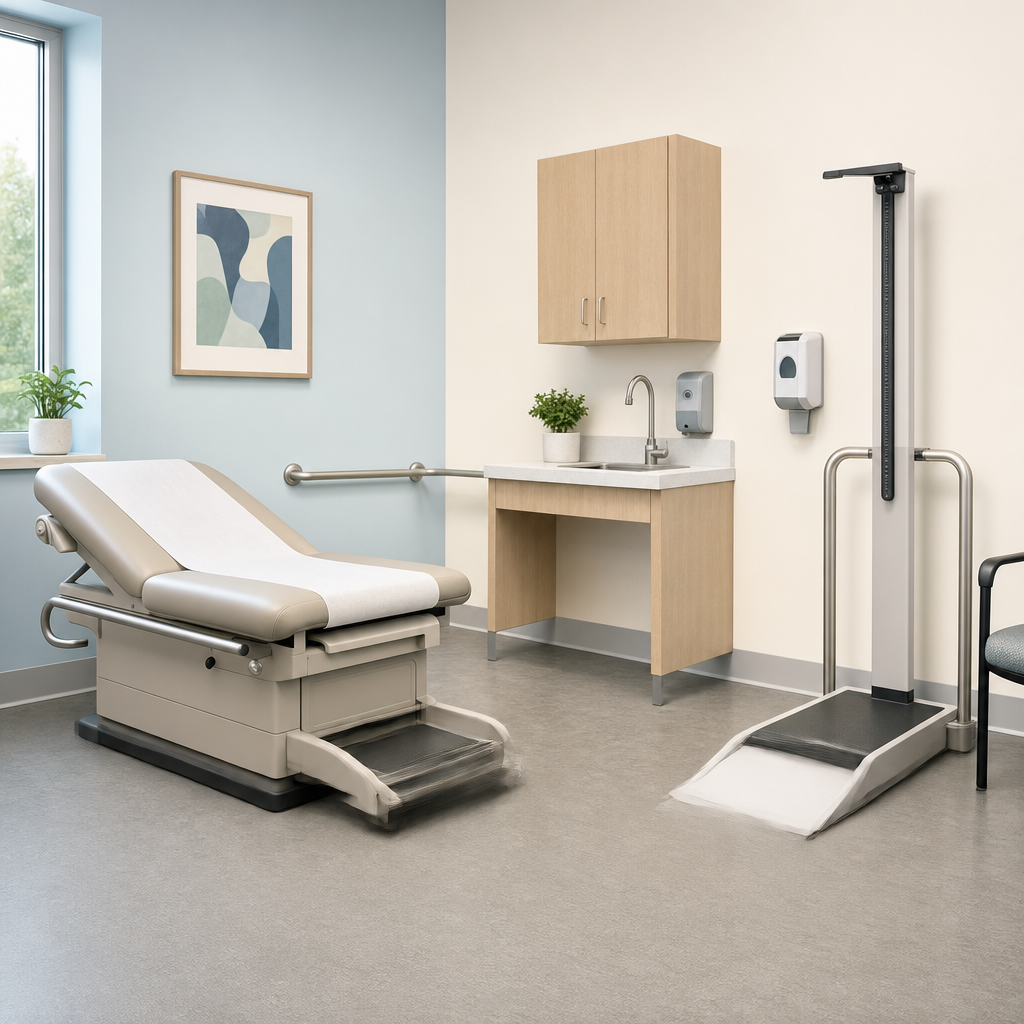
- Accessible exam tables: low transfer height range of 17 to 19 inches (the enforceable standard under both the HHS and DOJ rules, based on the U.S. Access Board’s MDE Standards); transfer surface minimum 21 inches wide and 17 inches deep; arm rails or transfer supports; base clearance not exceeding 26 inches.
- Accessible wheelchair scales: platform minimum 32 inches wide by 40 inches deep; 2-inch edge protection on platform and ramps; maximum ramp slope of 1:8.
- Accessible stand-on scales: slip-resistant platform; handrail supports on both sides; handrail height 34–38 inches from platform.
Even facilities that use exam tables or scales infrequently are subject to this requirement if the equipment is part of routine care delivery.
- August 9, 2026 — Broader MDE Compliance Milestone (DOJ Rule)
A companion DOJ rule, effective October 8, 2024, establishes August 9, 2026 as the deadline by which state and local government healthcare facilities must have at least one accessible examination table and one accessible weight scale — mirroring the HHS requirement.1 Because most publicly owned healthcare facilities also participate in Medicare and Medicaid, they are subject to the earlier HHS deadline as well. For all providers, this milestone signals that regulatory scrutiny of MDE accessibility will only intensify.
The 2026 Deadlines Are a Starting Point, Not the Finish Line
Beyond the immediate exam table and scale requirement, both rules establish ongoing scoping requirements for all MDE — meaning compliance obligations continue beyond 2026:1,2
- 10% of all MDE must be accessible (minimum one unit per equipment type) for general medical practices — physician offices, clinics, urgent care centers, and other outpatient facilities. New MDE acquired after the rules’ effective dates must already meet accessibility standards unless and until the scoping threshold is satisfied.
- 20% of all MDE must be accessible for providers that specialize in treating conditions affecting mobility, including outpatient rehabilitation and physical therapy facilities. This higher threshold reflects the greater likelihood that these providers’ patients will need accessible equipment.
- Equitable distribution is required: in facilities with multiple departments, clinics, or specialties, accessible equipment must be distributed proportionately across all areas that use MDE – not concentrated in one location.
- Staff training is mandatory: the rules require that clinical staff be trained to successfully operate accessible MDE and assist patients with transfers and positioning.
Understanding these requirements early allows organizations to make thoughtful, budget-conscious decisions, rather than reacting under deadline pressure with limited procurement options.
How Premier’s Innovatix GPO Supports Proactive Planning
Through Premier’s Innovatix GPO, CoC providers gain access to Premier contracted suppliers offering medical equipment designed to meet ADA and Section 504 accessibility requirements. The GPO model helps streamline procurement while preserving budget control, giving organizations a structured path to compliance. Available solutions through Premier contracted suppliers include:
- SECA — Wheelchair-accessible medical weighing solutions engineered to meet U.S. Access Board standards.
- Midmark — Height-adjustable exam tables and clinical furniture for accessible, patient-centered outpatient environments.
Additional Premier contracted suppliers are available through the portfolio. To see a full list of contracts, please click here. Early engagement is essential — procurement, installation, and staff training all take time, and the July 8, 2026 deadline is now weeks away.
Prepare Now. Protect Access. Strengthen Care.
Accessible medical equipment is foundational to safe and equitable care. Proactive planning today positions CoC organizations to meet upcoming requirements with confidence while protecting their federal funding relationships. To prepare:
- Conduct a full MDE inventory across all sites — exam tables, weight scales, and applicable diagnostic equipment.
- Assess against U.S. Access Board standards to identify which units currently meet accessibility requirements.4
- Prioritize immediate gaps — at minimum, one accessible exam table and one accessible scale per applicable location by July 8, 2026.
- Engage Premier’s Innovatix GPO to explore compliant options through Premier contracted suppliers (see below).
- Plan staff training in parallel with equipment acquisition — required under both the HHS and DOJ rules.
The regulatory environment around disability access in healthcare is not easing. Facilities that adapt early will be better positioned operationally, competitively, and from a risk-management standpoint. Accessible equipment is no longer an upgrade — it is becoming the baseline expectation for every care setting.
Engage Premier’s Innovatix GPO to explore compliant options through Premier contracted suppliers today
Ready to get started?
- https://www.federalregister.gov/documents/2024/08/09/2024-16889/nondiscrimination-on-the-basis-of-disability-accessibility-of-medical-diagnostic-equipment-of-state
- https://www.hhs.gov/civil-rights/for-individuals/disability/section-504-rehabilitation-act-of-1973/ocr-detailed-504-fact-sheet/index.html
- https://www.access-board.gov/mde/regulatory-assessment.html
- https://www.access-board.gov/mde/chapter-m3/
- https://www.federalregister.gov/documents/2026/05/11/2026-09266/extension-of-compliance-dates-for-nondiscrimination-on-the-basis-of-disability-accessibility-of-web